What happens during a mold inspection in McLean, VA?
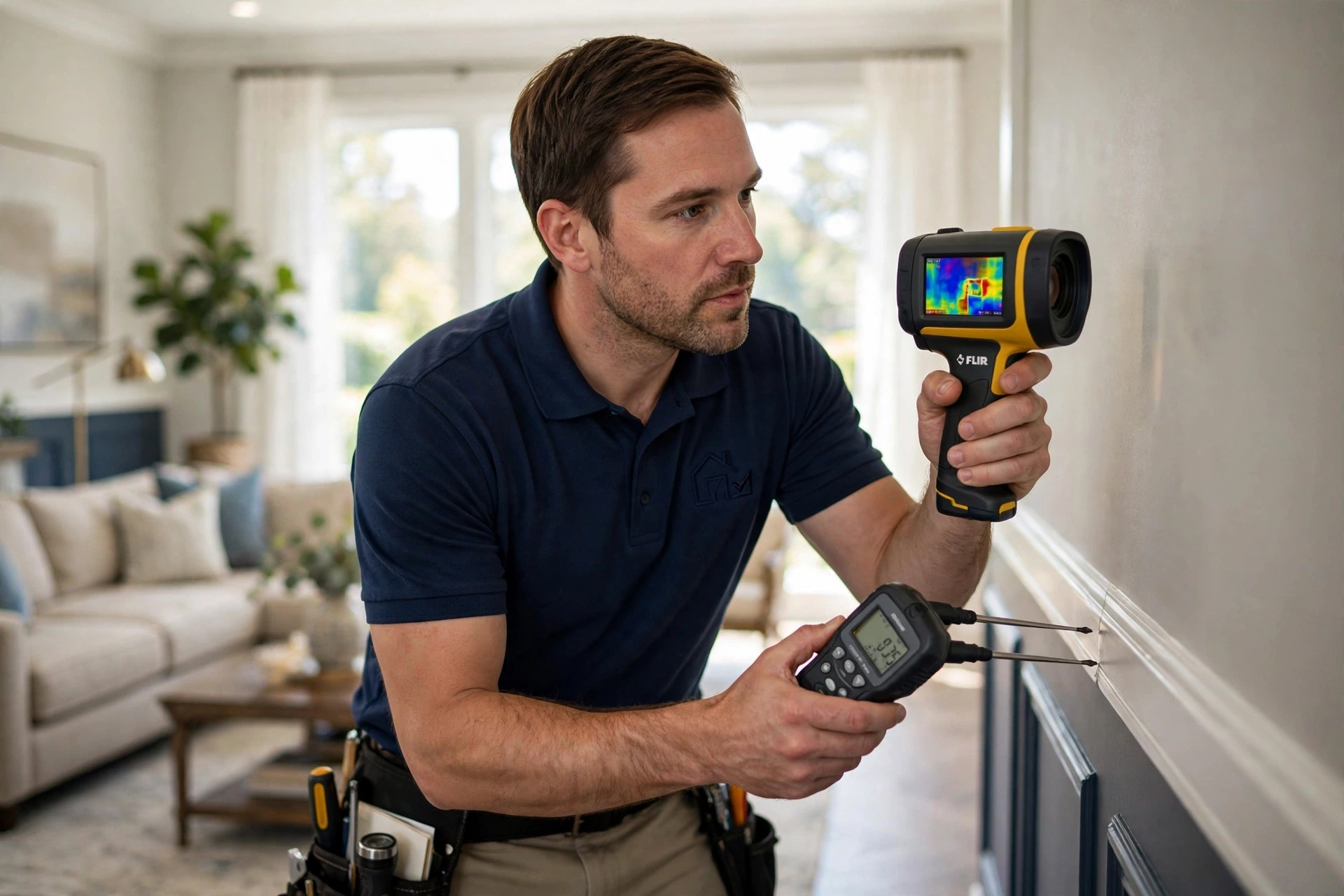
On every mold inspection McLean visit, we walk the whole house — not just the spot you're worried about. Basements and crawl spaces first, then attics, bathrooms, laundry areas, and anywhere plumbing runs through walls. We take moisture readings with meters, look for staining and visible growth, check grading and drainage outside, and trace how water might be getting in. In a 1950s rambler in McLean Hamlet or a split-level in Lewinsville, that often means finding the one failed detail — a disconnected downspout, a sump that can't keep up — behind a much bigger symptom.
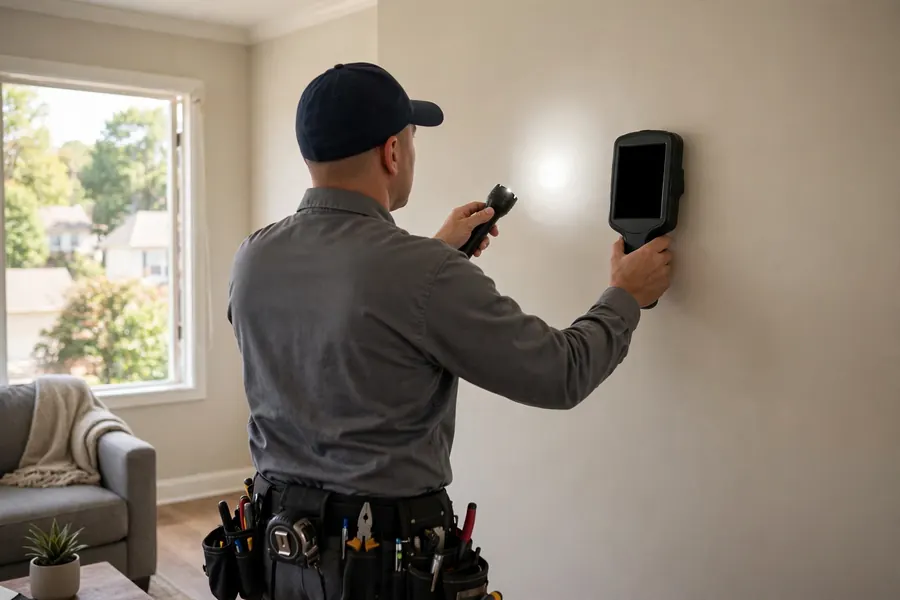
Locate. Moisture mapping for hidden growth — pin and pinless readings through drywall, staining and visible growth logged per location, grading and drainage checked outside. The deliverable is a map of where the growth is and where the water comes from.
Scope. A written, priced scope — affected areas, moisture source, containment, what is removed versus cleaned, verification — written so it can go into a negotiation, an insurance file, or a landlord’s file. The deliverable is the document, with a fixed price.
Verify. Post-remediation clearance by an independent party — moisture readings and, where testing is warranted, lab results from a third party, not the company that did the work. The deliverable is the clearance report that closes the file.
What a real inspection includes, step by step
A proper inspection is not a walkthrough with a flashlight. Inspection firms across the country publish nearly identical protocols, and the EPA's own training course follows the same sequence — every step exists because skipping it has burned someone before:
Occupant interview
Leak history, repair records, odor patterns, seasonal moisture. This focuses the entire visit.
Room-by-room visual
Every accessible area — odors, staining, visible growth — documented with a photo log.
Moisture meters
Pin and pinless readings on drywall, wood, concrete and subfloors, logged per location.
Thermal (FLIR) scan
Temperature anomalies behind walls and ceilings, no demolition. Every anomaly gets confirmed with a meter.
Attic
Roof sheathing, insulation, exhaust vent terminations. Bath fans vented into the attic are a classic find.
Crawlspace / basement
Vapor barrier, ground moisture, plumbing condition, wood-rot indicators, sump function.
HVAC system
Air handler cabinet, coils, drain pans, condensate lines and routing. A common hidden source.
Exterior
Foundation clearance, grading and slope, gutters, downspouts, window and door sealant.
Targeted sampling
Air or surface samples only when they answer a defined question — never willy-nilly.
Written report, 24 hours
Photos, moisture data, findings, and a fixed-price scope of recommended work.
Mold testing types, explained honestly
Four methods cover nearly every residential situation. Each answers a different question — and each has limits the lab brochure won't lead with:
| Test | What it tells you | When to use it | Typical lab cost |
|---|---|---|---|
| Spore trap (air sample) | Spore counts by species, reported as spores/m³ — interpreted against an outdoor control taken the same day | Suspected hidden growth, post-remediation verification, real-estate documentation | $75–$150 per sample |
| Tape lift / swab | Whether visible growth is actually fungal, and which genus | Confirming a suspicious stain is mold rather than dirt or soot | $75–$150 per sample |
| Bulk sample | The most accurate identification — a piece of the material itself goes to the lab | When surface sampling can't settle the question | $75–$150 per sample, plus the repair |
| ERMI (dust DNA) | DNA-based analysis of settled dust across 36 mold groups; produces a relative moldiness score | Health-concern or chronic-exposure cases — not routine scoping | Several hundred dollars |
The honest fine print. Even collected perfectly, spore-trap results are "at best, semi-quantitative," per AIHA — indoor and outdoor air vary by the hour, and counting carries inherent variability. Standard protocol draws 15 liters per minute for a 75-liter sample, always paired with an outdoor control. A tape lift says nothing about your air quality. ERMI catches species that microscopy misses, but some remediators use high readings of harmless common molds to frighten clients — the score needs an honest interpreter.

When testing is worth it — and when it's a waste
The EPA's position is the anchor for this whole subject: "In most cases, if visible mold growth is present, sampling is unnecessary." No federal limits exist for mold or mold spores, so a lab result cannot pass or fail your house. The EPA's practical rule is blunter still: "Unless the results would or could make a change in your plans, you don't need to sample."
✓ Worth it
- Musty odor with no visible source — suspected hidden growth
- Post-remediation verification, done by an independent tester
- Real-estate documentation — pre-listing proof or buyer disputes
- Health-concern cases where species data guides decisions
✕ A waste
- Visible growth with an obvious moisture source — spend the money on the fix
- Routine "peace of mind" screening with no symptoms, odor, or water history
- A single pre-purchase air sample with no inspection context — what's in the air changes all the time
- Any test whose result wouldn't change what you do next
Maine's and Minnesota's health departments say the same thing another way: testing can be useful as part of an investigation, but it is never a substitute for a thorough visual inspection. Every investigation has to answer two questions — where is the mold, and what moisture is feeding it. If both can be answered without a lab, the lab is a poor use of money.
What inspection and testing cost in McLean
Mold inspection McLean ranges, because every house is different — but honest ones:
| Service | Typical range | What's included |
|---|---|---|
| Professional inspection | $300–$600 | Visual assessment, moisture meters, photo log, written report |
| Comprehensive inspection | $350–$700 | Adds thermal imaging, HVAC evaluation, attic and crawlspace detail, priority report |
| Lab analysis | $75–$150 per sample | Added per air or surface sample, on top of the inspection |
| ERMI dust analysis | Several hundred dollars | DNA-based; health-concern cases only |
A working rule from a working mold pro: an inspection priced far under $300 isn't bringing the tools that find hidden problems. And one that costs nothing isn't an inspection at all — it's a sales call. A real inspection is a standalone product with a fixed price, never a funnel into a remediation quote. For remediation pricing once an inspection finds growth, see our McLean mold removal cost guide.
10 mistakes homeowners make with mold testing
Nearly every bad testing story starts with one of these:
1 The hardware-store petri kit
Settle plates only catch spores heavy enough to fall out of the air — and every home on earth will grow something on the dish. A positive means nothing; a negative proves nothing. One lab owner discarded $300,000 worth of consumer kits on camera and called them completely worthless.
2 Testing without a plan
The EPA says to develop a "confirmable theory" first: decide what you think is happening and what result would prove or disprove it — before anyone opens a cassette.
3 Skipping the outdoor control
Indoor spore counts are meaningless without an outdoor sample taken the same day. After remediation, indoor air should resemble outdoor air by species and concentration — that comparison is the actual benchmark.
4 Taking the cheapest — or no-cost — inspection
Under-$300 inspections skip the thermal camera and the crawlspace. No-cost inspections are sales calls wearing an inspector's badge.
5 Letting the remediator clear their own work
The crew that did the remediation has a vested interest in passing. Clearance testing belongs to someone who answers to you, not to them.
6 Painting over it
Paint traps moisture behind the film, and the growth eventually bursts through. Working pros have a blunter name for this one.
7 Running a dehumidifier instead of fixing the leak
If a pipe is dripping inside the wall, the dehumidifier is drinking the air while the wood stays wet. Dry the air all you want — the source wins.
8 Treating a home inspector's note as a diagnosis
InterNACHI standards exclude mold from general home inspections. "Suspected microbial growth" means "hire a specialist," not "you have a mold problem."
9 Tearing into walls to "check"
Disturbing hidden growth without containment causes a massive spore release — the EPA's words, not ours. What's behind the drywall stays there until someone contained is ready.
10 Expecting a pass/fail number
No federal mold limits exist. Nobody can certify your air as "passed" — anyone selling that certainty is selling something else.
Why inspection and remediation should be separate
The company that profits from the fix should not be the one grading the problem. When one firm both finds the mold and sells the cleanup, every finding is suspect — which is exactly why New York made it illegal: since 2016, the same company may not perform both mold assessment and remediation on the same project, with penalties of $2,000–$10,000. The state's stated reason was companies exaggerating small problems to sell big cleanups.
Virginia's rule: certification is now the law
Virginia law (HB 1270, updated by HB 2195 in 2025) requires certification from a nationally or internationally recognized certifying body to sell residential mold remediation in the Commonwealth — and Virginia regulations require professionals to disclose conflicts of interest. Ask any contractor for both, in writing, before you sign anything.
How we work: inspections are sold as a standalone product — a fixed price for the visit, the readings, and the written report. If remediation follows, we recommend independent post-remediation verification: clearance testing done by someone who answers to you, not to the crew that did the work. That's not a knock on any contractor. It's how you know the job is actually done.
Should McLean sellers get a mold inspection before listing?
Here's the local reality: at McLean's median home price, a buyer's home inspector writing "suspected microbial growth" can crater a deal or trigger a five-figure credit demand. Sellers from Chesterbrook to Potomac Hills call us for pre-listing inspections so they can remediate on their own timeline and hand buyers clean paperwork. Buyers call us when an inspection flags something in that dream colonial off Chain Bridge Rd — we give you a real scope and a real number, which is far more useful at the negotiating table than a vague fear.
What do you get after a mold inspection?
A plain-English report: what we found, where the moisture is coming from, what we'd do about it, and what it costs — fixed, in writing. If the honest answer is "this is minor, here's what to watch," we'll say that too. No obligation, no pressure, no scare tactics.
What does a home's era tell a McLean inspector?
In Northern Virginia, the decade a house was built predicts where we look first. 1950s ramblers in Pimmit Hills mean vented crawl spaces, original clay drain tile, and additions sitting on their own foundations. 1960s–70s brick colonials in Chesterbrook and the Langley area mean finished basements, aging HVAC condensate lines, and bath fans vented into attics instead of outside. Split-levels in Lewinsville mean stacked plumbing, garage-adjacent laundry, and walkout lower levels where the original grading has had sixty years to settle. Each era has a fingerprint, and a good inspector reads it before opening a single access panel.
Era also tells us what "normal" looks like. A stone foundation in an older Langley home wicks moisture by design; a 1970s poured wall in Chesterbrook should not. Original windows in a McLean Hamlet rambler will condense on a January morning — that is physics, not failure. Knowing the difference is half the value of an inspection done right: it keeps us from recommending work you do not need.