Serving McLean & Northern Virginia • On-Site Inspections (571) 749-1606•Book an Inspection
Commercial Mold Remediation — McLean, VA

Commercial Mold Remediation in McLean, VA

McLean Mold Solutions provides commercial mold remediation for McLean businesses — offices, retail, restaurants, and multi-unit buildings. Discreet crews, after-hours scheduling, documentation your tenants and insurers expect.

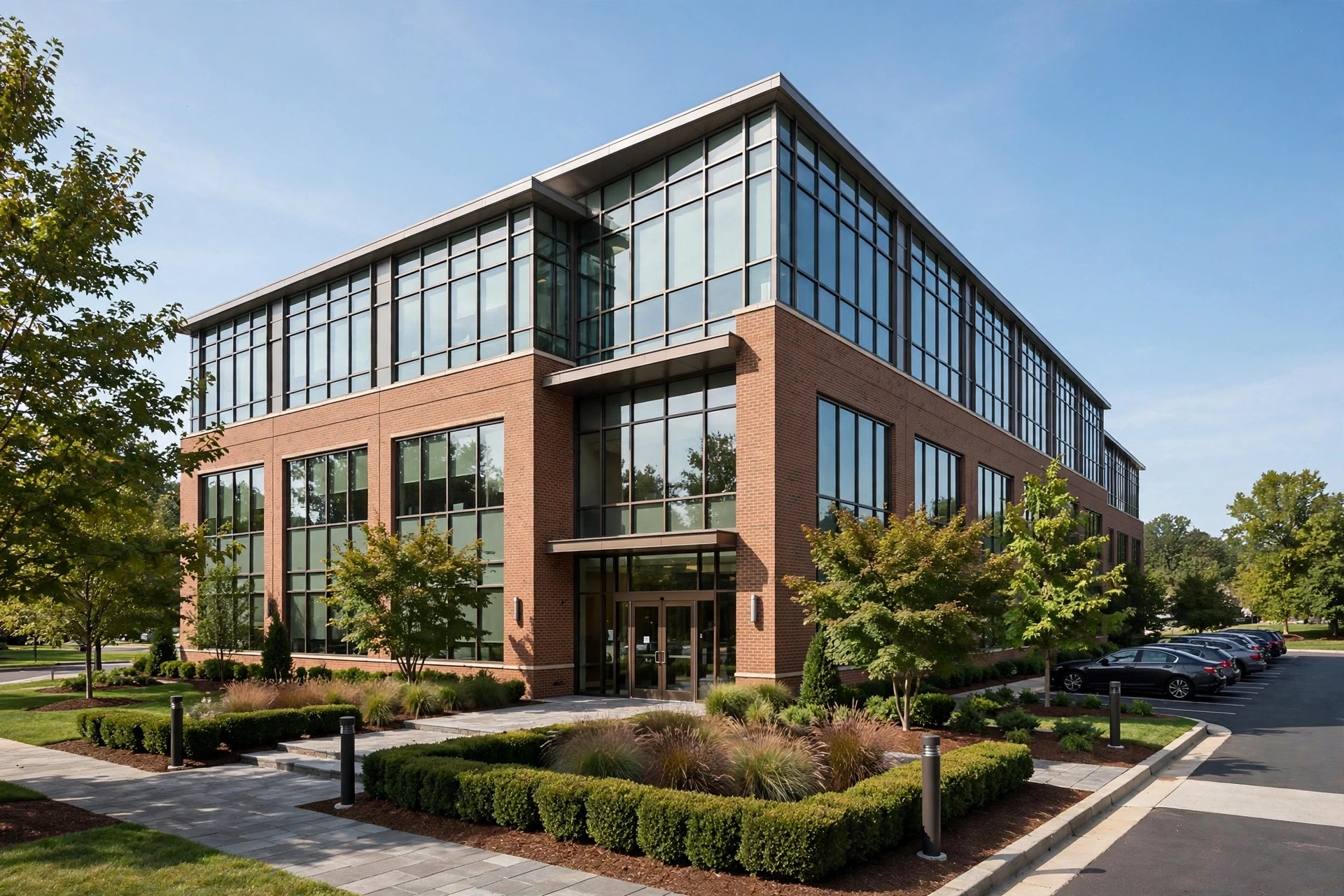
Modern suburban commercial office building exterior in Northern Virginia

Can commercial mold remediation avoid disrupting business?

Yes. We schedule assessment and remediation around your operations — evenings, weekends, phased by zone so part of your space stays open. A musty conference room off Chain Bridge Rd or growth behind a McLean retail stockroom can't wait for a convenient time, but it also can't shut you down. Containment keeps work invisible and odor-controlled from customers and staff, and daily cleanup means you open doors each morning to a normal-looking business.
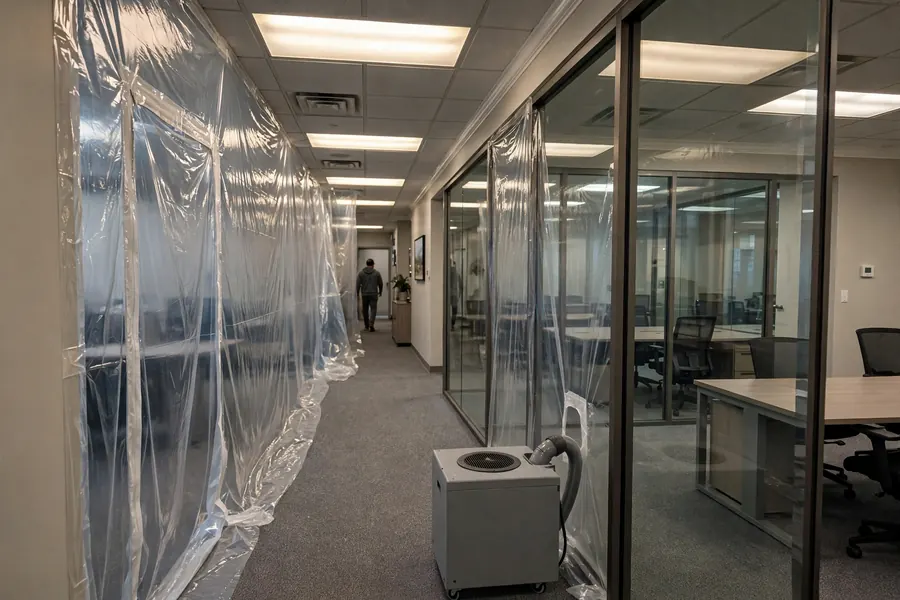
Office hallway after hours with containment barriers and an air scrubber

Do you work with property managers and HOAs in McLean, VA?

Condo associations and apartment managers from the Rotonda to garden-style complexes inside the Beltway call us for the same cluster of issues: unit-level bathroom and kitchen leaks that spread to common areas, HVAC condensate problems in mechanical rooms, and ground-floor moisture where grading meets the building. We document everything — photos, moisture readings, scope, completion verification — in the format boards and insurers actually want to see.
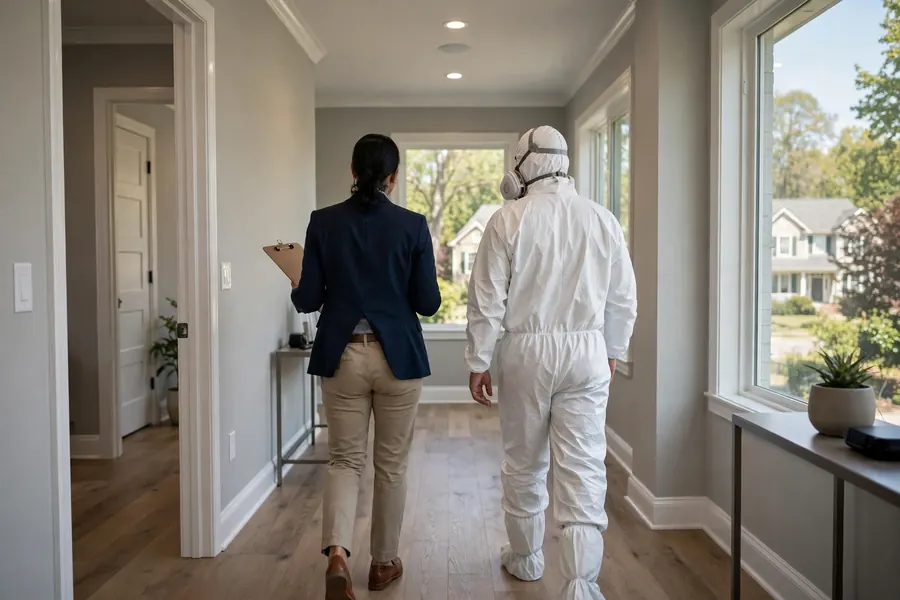
Property manager walking through a commercial space with a remediation technician

What does a commercial mold scope include?

Everything residential does, scaled up and scheduled smart: containment engineered for occupied spaces, HEPA-filtered negative air, off-hours work windows, a single point of contact who answers the phone, and a written scope with a fixed price approved before mobilization. For larger facilities we can phase by floor or wing so operations continue throughout.

How commercial work is run

Commercial work starts with an independent assessor and a written protocol — not with a crew and a sprayer. The crew then works to the IICRC S520 standard: containment with HEPA-filtered negative air, removal of colonized porous material, moisture-source correction, and independent post-remediation verification.

Occupied space stays open where it can: work is phased by floor or wing, and night and weekend crews are scheduled in the written proposal so tenants and customers are not disrupted. Every job closes with a binder — daily logs, pressure and moisture readings, waste manifests, a photo log, and the independent clearance report. Before mobilization, ask for a certificate of insurance naming the owner or manager as additional insured.

One honest limit: the Virginia certification provision covers residential dwellings only — it does not compel anything for commercial buildings. The same certification-and-S520 benchmark is still what a careful commercial buyer should demand when hiring; the law simply does not require it here.

How discreet is commercial mold work?

Unmarked vehicles on request, crews in clean uniforms, no signage, no drama. Your customers see a maintenance visit; your staff sees a problem being handled. In our experience, that's what McLean businesses actually want — the problem solved quietly and correctly.

What does McLean-area commercial stock look like from a moisture perspective?

The commercial buildings along the Chain Bridge Rd and Dolley Madison Blvd corridors span several eras: 1980s office blocks with aging rooftop units, retail strips with flat roofs that pond after heavy rain, and garden-style condo communities with shared-wall plumbing runs and ground-floor units where grading meets the building envelope.

McLean's commercial corridors also include professional offices and medical suites tucked into converted residential buildings — spaces where a slow plumbing leak above a drop ceiling can go unnoticed for months. Our commercial inspections cover both the obvious mechanical areas and the quiet ones: above ceilings, behind break-room walls, and around every rooftop penetration.

The operational reality shapes our approach as much as the buildings do. Retail and restaurants cannot close, offices run on tenant schedules, and property managers need documentation that satisfies boards and insurers in one package. So we scope commercial work around the building's rhythm — off-hours windows, phased zones, a single point of contact — and deliver the photo documentation, moisture readings, and completion verification that make the file complete.
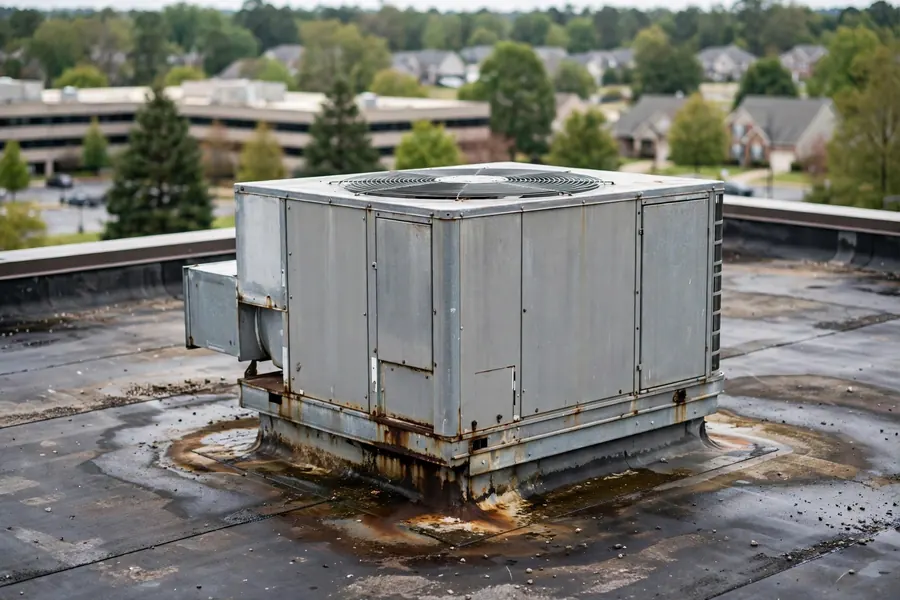
Commercial rooftop HVAC unit with moisture staining at its base
Detailed inspection, honest scope. Every commercial remediation job starts with an on-site visit — moisture readings, growth mapping, and a written plan with a fixed price. Book yours here or call (571) 749-1606.
Related services

Often needed together

Mold Remediation

Contained removal of visible growth, HEPA-filtered cleanup, and moisture-source correction — done to a written scope.

Mold Inspection & Testing

A careful on-site look for visible growth, moisture readings, and the conditions that let mold take hold.

Black Mold Removal

Fast, contained response for dark or widespread growth — inspection first, then a clear remediation plan.

What does IICRC S520 say about mold conditions?

Serious commercial work follows IICRC S520, the ANSI-accredited Standard for Professional Mold Remediation. S520 sorts every job into one of three conditions — and the condition drives the entire scope, from containment to cost:

ConditionWhat it meansWhat's required
Condition 1Normal fungal ecology — typical indoor/outdoor spore balanceNo remediation needed
Condition 2Settled spores in dust, no active growthHEPA vacuuming + damp wiping
Condition 3Actual growth, visible or hiddenFull containment + material removal or cleaning

One rule surprises many property managers: any mold growth inside the HVAC system automatically counts as Condition 3 — ductwork distributes spores through the whole building, so it gets the full protocol. And the standard's goal is worth knowing upfront:

“Remediation returns materials to normal fungal ecology — not sterilization.” — IICRC S520

Sterilization isn't the target; removing active growth and correcting the moisture source is. That's also why S520 lists five principles in order: protect health and safety, document conditions, control the contaminant at the source, physically remove it, and fix the moisture so it can't return.

What does real containment look like on a commercial job?

Containment isn't plastic sheeting and a box fan. S520 defines three levels — source containment for small amounts, local or “mini” containment for moderate growth, and full-scale containment with critical barriers, airlocks, and negative pressure for extensive work. The physics matter:

  • Negative air: the work zone holds at roughly −4 to −6 pascals versus surrounding areas, so air always flows in, never out. Too much vacuum stresses the poly sheeting; pros monitor it continuously with a manometer.
  • Air changes: S520 specifies a minimum of 4 air changes per hour inside containment, with 6 or more preferred during active remediation.
  • HEPA filtration: true HEPA captures 99.97% of particles 0.3 microns and larger — and the filtered air is exhausted outdoors, not recirculated.
  • Chemicals aren't the fix: S520 treats biocides as adjuncts only. As the standard puts it, they should never substitute for physical removal.

“You cannot replicate this with plastic sheeting and a box fan. When spores become airborne during removal, they settle on every surface.” — Industry best-practice guidance

That's the real cost of hiring a general handyman crew for mold: the work looks done, but spores settle across the office — and the next tenant complaint lands on your desk, not theirs.

Why is S520 documentation your legal shield?

For offices, retail, and multi-unit buildings, the paper trail is half the job. A defensible record — what was found, what was removed, what moisture was corrected — is what you show an insurer, an owner, or a court if a tenant or employee ever claims health effects from mold. Following an ANSI-accredited standard gives you a defensible position; skipping it gives you a story.

Virginia adds a legal layer: under VA HB 2195 (2025), anyone selling residential mold remediation in the Commonwealth must hold certification from a nationally or internationally recognized certifying body — and must comply with the pertinent standards while doing the work. The Restoration Industry Association summarizes it this way:

“The bill prohibits the selling or offering for sale of services as a professional mold remediator to be performed upon any residential dwelling without holding a mold remediation certification from a nationally or internationally recognized certifying body.” — Restoration Industry Association on VA HB 2195

And one operational fact most managers don't expect: commercial projects often don't require full vacancy. Containment zones with negative air and HEPA filtration let unaffected floors and wings keep operating while the work zone is sealed off — which is exactly why we schedule assessment and remediation around your business hours, including after-hours and weekends.

FAQs

Commercial Mold Remediation — questions we hear in McLean

Yes — that's the core of our commercial service. Evenings, weekends, and phased zone-by-zone work keep you operational. We'll build the schedule around your hours in the written scope.

Regularly. We provide the documentation boards need: inspection findings, photos, scope, timeline, and completion verification — plus a single point of contact.

Yes — from individual condo units to mechanical rooms and common areas. We coordinate access with management and keep residents informed without alarming anyone.

Every commercial job includes photo documentation, moisture readings, the written scope, and a completion report — exactly what carriers and boards ask for.

Call us and we'll give you an honest earliest slot. Active water situations get priority — standing water doesn't care about business hours.

Yes, where phasing allows — work is phased by floor or wing and night or weekend crews are planned in the written proposal so occupied areas stay open. Confirm your operating hours at scoping so the schedule is built around them; we do not promise a specific schedule in advance.

The closeout binder: daily logs, pressure and moisture readings, waste manifests, a photo log, and the independent clearance report. Confirm the format at the bid stage so it matches what your board or insurer needs.

Not sure what you're dealing with? Start with an inspection.

Every remediation job begins with a careful look. We'll find the moisture, map the growth, and give you a written plan — with no pressure.