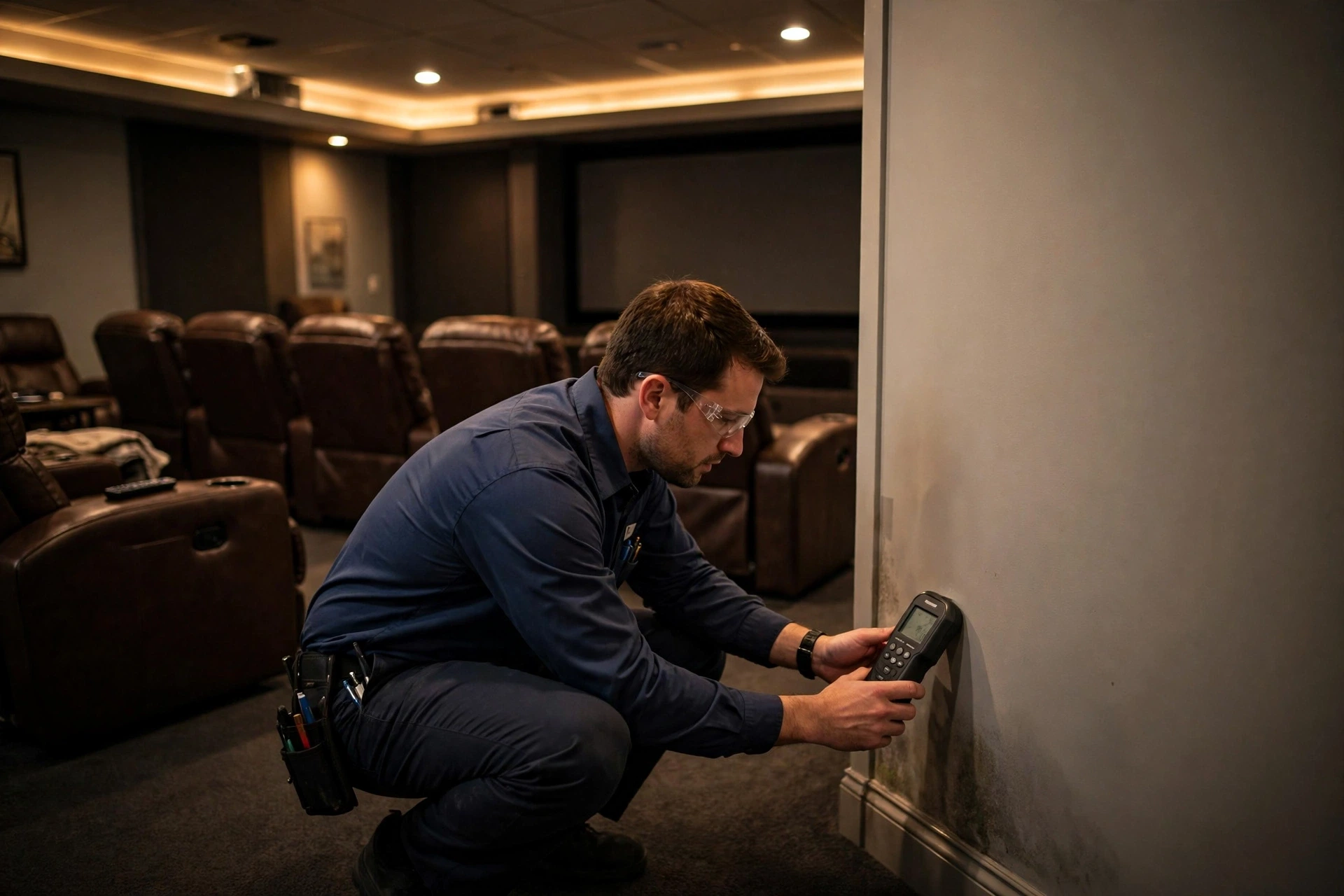
How do you remediate a finished basement without gutting it?
We remove only what can't be salvaged — typically the affected drywall run and the insulation behind it — and HEPA-vacuum and clean the framing and masonry, all inside sealed containment with HEPA-filtered negative air. In McLean's 1950s–70s brick colonials and split-levels, the finished basement is often the best room in the house: the theater room in Evanswood, the in-law suite in Chesterbrook, the home office that's been someone's full-time workplace since 2020. When mold takes hold behind that drywall, it's not a storage-room problem — it's a five-figure renovation at risk. Our containment and removal process is designed around finished space: sealed zones, HEPA-filtered negative air, careful section-by-section removal, and daily cleanup so the rest of your home stays livable.
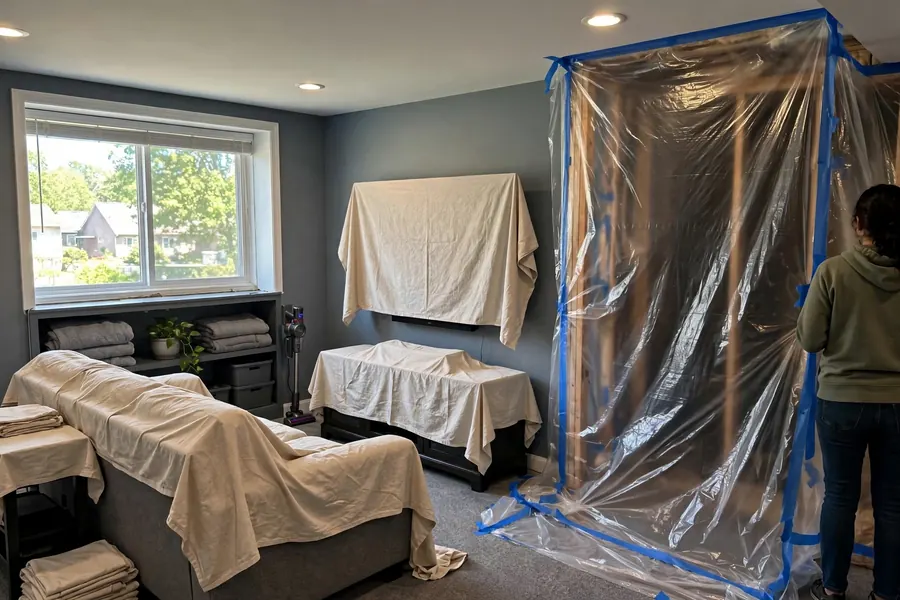
Why do McLean, VA basements get wet?
Five usual culprits: sump pumps that quit — or never existed — when a spring nor'easter drops inches of rain overnight. Grading on sloped lots in Lewinsville, Potomac Hills, and West McLean that directs water toward the foundation. Downspouts discharging right at the footing. Hydrostatic pressure pushing moisture through older block or poured walls along Old Dominion Dr. And the quiet one: a finished basement sealed up tight with no dehumidification, where humid NoVA summer air condenses on the cool foundation walls behind the drywall for months.
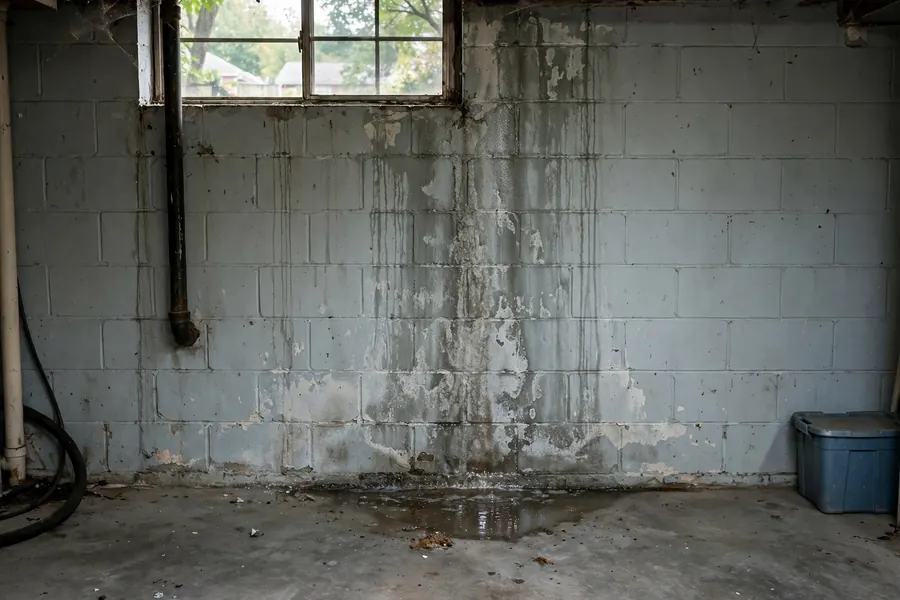
Where the water comes from in a McLean basement
Before any scope is written, the inspection names the water source — because the fix follows the source, not the stain. The five we see most:
- Clay-heavy soil and hydrostatic pressure — saturated soil pushes water through the wall/floor joint and hairline cracks, found with moisture readings at the joint.
- Settled grading and window wells — ground that slopes toward the house, or a well that fills in a storm, sends water straight to the wall.
- Sump-pump failure — a pump that quits, or never existed, in a spring nor’easter can put inches of water in overnight. The inspection checks the pump and whether a backup is in place.
- Slow plumbing drips — a pinhole leak behind a finished wall feeds a colony for months with no visible flood.
- Summer humidity — humid air condensing on cool foundation walls behind drywall, in a basement sealed tight with no dehumidification.
What does basement mold removal in McLean, VA involve?
After the detailed inspection maps the growth and the water path, the written scope typically includes: containment of the affected area, removal of unsalvageable drywall/insulation in sections, HEPA vacuuming and antimicrobial cleaning of framing and masonry, and — critically — the moisture correction. That might mean a sump pump replacement or backup, regrading recommendations, downspout extensions, or a properly sized dehumidifier. We fix causes, not just symptoms.
How do you keep a McLean basement dry after remediation?
We'll leave you with plain-English guidance: what humidity level to hold, where to watch after the next big storm, and when to call us back for a recheck. Most of our basement clients never need us twice — that's the goal.

Which McLean neighborhoods see the most basement moisture?
Some McLean streets keep us busier than others, and topography explains most of it. Homes on the Potomac-facing slopes and in the low pockets of Potomac Hills and West McLean deal with both surface water running downhill and a high water table pushing up — the classic double hit. Lewinsville's split-levels sit on lots where the original 1960s grading has had sixty years to settle toward the foundation. Along Old Dominion Dr, older block foundations meet mature tree roots that quietly shift drainage patterns decade by decade.
Then there is the finished-basement factor. In Chesterbrook and Evanswood, the basement is often the nicest room in the house — theater, in-law suite, office — which means it is sealed up tight, carpeted, and drywalled over foundation walls that used to breathe. Without dedicated dehumidification, humid NoVA summer air condenses on those cool walls behind the drywall for months. The nicest basements are often the most vulnerable, which is exactly why we size dehumidification into the scope rather than treating it as an afterthought.
Why Below-Grade Spaces Grow Mold: The Building Science
Concrete looks solid, but it is far more porous than it looks. Water vapor seeps through walls and floors through capillary action — liquid water wicking upward against gravity through concrete’s tiny pores, several feet up from the footing. Even with no visible cracks, moisture vapor transmits through concrete under sustained soil pressure.
Building-science literature identifies three moisture pathways into a basement:
- Bulk water leaking in — rain and groundwater finding cracks and joints.
- Capillary action through porous masonry — described as working “like a sponge or paper towel.”
- Water vapor and condensation. When humid air hits a surface below the dew point, water condenses. Basement walls are cool year-round; summer’s warm humid air means condensation on those cold walls. One mold inspector documented a client who grew growth on basement drywall after leaving the AC running constantly while away — cold walls plus high relative humidity equals condensation equals growth.
The numbers that matter: when relative humidity climbs above roughly 60%, mold risk begins — and above 80%, risk climbs sharply. EPA guidance is to keep indoor RH below 60%, ideally 30–50%. Mold begins growing within 24 to 48 hours on wet materials.
One more building-science warning: fiberglass batts pressed directly against concrete are among the worst finished-basement setups. Foundation walls constantly wick moisture from surrounding soil, and fiberglass traps that moisture against the concrete. Growth colonizes the paper facing, the back of the drywall, and the bottom plate — and stays hidden behind the finished wall for months.
9 Moisture Sources: The Diagnostic Checklist
Every basement job we scope starts by finding the water. Here is the checklist we work through, in the order of how often each one turns out to be the culprit:
Foundation cracks
Even hairline cracks admit bulk water under hydrostatic pressure.
Cove joint
Where the wall meets the floor slab — the #1 seepage path in poured foundations.
Hydrostatic pressure
Groundwater forced through walls and slab when the water table rises.
Poor exterior grading
Soil sloping toward the foundation lets rainwater pool against walls and work inside.
Gutter and downspout failures
Clogged gutters and downspouts discharging at the footing. “Make sure you have 6 inch gutters that run away from the house and are clean.”
Sump pump failure
Dead pump or no battery backup during a power outage — a flooded basement overnight.
Plumbing leaks
Supply lines, water heaters, and washing-machine hoses routed through the basement.
Condensation
Warm moist air meeting cool concrete — the quiet, invisible source.
Window wells
Failed seals and clogged well drains letting storm water pour in.
Efflorescence vs. Mold: The White-Powder Test
That white powdery coating on basement walls is the most common homeowner misdiagnosis we see. Efflorescence is mineral salt left behind when water migrates through concrete and evaporates. It is not mold, and it is not alive.
| Characteristic | Mineral efflorescence | Fungal mold |
|---|---|---|
| Texture | Chalky, crystalline, brittle — crumbles to fine salt dust | Slimy, fuzzy, or velvety — smudges under pressure |
| Water reaction | Dissolves instantly like table salt | Repels water or gets slicker |
| Color | Pure white, light gray, occasionally dull yellow | Dark green, charcoal, jet black, dark brown |
| Odor | Odorless | Earthy, musty, pungent |
Finished vs. Unfinished Basements: Two Different Jobs
Unfinished basements are mostly non-porous surfaces — concrete and block. Scrub-and-dry work applies: wash, fix the water source, ventilate well for days. As one homeowner put it: “If it is just concrete and walls, not big deal, just wash and find the problem and fix it.”
Finished basements are a different job entirely. Drywall, wood studs, fiberglass insulation, carpet — all porous, all mold food. “Finished basements are usually worse because drywall traps moisture quietly for months before anyone notices.”
The rules after water exposure:
- Flood-cut rule: remove drywall 2 feet above the visible wet line and discard it.
- Carpet padding: remove all of it — it cannot be salvaged after wetting.
- Wet fiberglass insulation: remove and replace; it does not dry clean.
- Wood framing: can sometimes be saved — sanding, HEPA vacuuming, and damp wiping, or encapsulation with primer.
Prevention That Actually Works
Remediation without prevention is a subscription, not a solution. Two things keep a basement dry long-term: controlled humidity and managed water.
Dehumidifier sizing (Consumer Reports / DOE 2020 standard)
| Basement size | At 60–70% RH | At 80–90% RH |
|---|---|---|
| 800 sq ft | 40-pint | 50-pint |
| 1,200 sq ft | 50-pint | 60-pint |
Set the humidistat to 45–50%, not lower. Drain continuously if possible, and clean filters every two weeks in peak season. One reality check: a 50-pint unit rated under current DOE standards extracts roughly 30–35 pints per day in a typical basement — that is correct operation in real conditions, not failure. And without air movement, readings vary widely across a basement: “You can have 45% in one corner and 60% just 25 feet away.” Target 50% at the unit so far corners stay around 55–57%.
Waterproofing options and costs
| Approach | Typical cost | Best for |
|---|---|---|
| Interior perimeter drain + sump pump | $3,000–$8,000 | Quick relief, tight budgets, no excavation |
| Interior drain tile | $40–$85 per linear foot | Component pricing |
| Sump pump (installed) | $800–$2,000 | High water table areas |
| Battery backup pump | $600–$1,500 | Power-outage protection |
| Crack injection | $300–$1,000 per crack | Isolated cracks |
| Exterior excavation + membrane | $8,000–$20,000+ | Long-term protection, severe cases |
Interior work is less disruptive and often recommended when exterior excavation is not feasible. The cheap fixes come first: soil sloping away from the foundation, downspouts discharging 6+ feet out, and 6-inch gutters in heavy-rain areas. For context, basement remediation itself typically runs $500–$3,000 depending on scope.
Cost Factors in McLean
Basement jobs here typically run $500–$3,000 for remediation, with interior waterproofing at $3,000–$8,000 when the water source needs a built system. Four things move the number inside those ranges:
- Finished vs. unfinished. An exposed concrete wall is mostly scrub-and-dry work. A finished basement means drywall, insulation, and carpet coming out — the flood-cut rule alone removes drywall 2 feet above the wet line, and wet carpet padding and fiberglass insulation cannot be salvaged.
- How much area is affected. A small surface patch and a full wall run behind finished walls are different scopes, and the written fixed-price quote is built on that scope.
- Whether the moisture source is fixed. Remediation without prevention is a subscription, not a solution — if the job needs a sump, interior drain, or grading correction, that sits in its own range.
- What stays dry afterward. A properly sized dehumidifier holding 45–50% humidity is part of keeping the space dry long-term, and we size it into the scope rather than treating it as an afterthought.
Every job gets a written fixed-price scope after the on-site inspection. Our McLean mold removal cost guide breaks the same ranges down by area and access.
DIY vs. Pro: The Bright Lines
You can handle it
- Surface growth on non-porous concrete or block, under 10 sq ft total — EPA’s bright line
- Method: dampen first (keeps spores down), scrub with a brush + non-ammonia detergent or 1:1 vinegar/water, 15-minute dwell, rinse, dry thoroughly with fan or dehumidifier
- PPE minimum: N95/P100 respirator, goggles, gloves
Call a professional
- Area exceeds 10 sq ft
- Growth in HVAC ducts
- After flooding with potentially contaminated water
- Drywall, insulation, carpet padding, or hidden wall cavities involved
- Occupants with asthma, immune disorders, or health concerns
- It keeps coming back — “recurring mold often signals hidden moisture problems like foundation leaks… that require specialized equipment to diagnose”
McLean Basements: The Clay-Soil Problem
Fairfax County sits on marine clay deposits that “act like giant sponges, absorbing enormous quantities of water… retain water for extended periods, creating persistently wet conditions around home foundations long after visible puddles disappear.” Unlike permeable soils, clay holds moisture at saturation levels that can persist for weeks — which is why McLean homeowners discover seepage weeks after the last rainfall.
Combine that with roughly 40 inches of annual rainfall and the county’s 1960s–70s colonials — whose original waterproofing expired decades ago and whose finished basements were added later over 50-year-old foundation walls — and you get the most common basement story in McLean: a dry-looking lower level that quietly feeds growth behind finished walls until the musty smell gives it away.
Drying clay-country basements takes more than fans
Clay-held moisture means standard drying timelines do not apply here. Industrial dehumidification with verified moisture readings — not just open windows and a box fan — is what actually gets a McLean basement dry after remediation. We size drying equipment to the space and confirm with meter readings before we call a job done.